





A broken bone rarely gives you time to think. Someone falls off a ladder, a child lands wrong on the playground, a scooter slips on a wet road, and suddenly you are the one standing closest to the injury.
When you suspect a fracture, keep the injured person still, support the limb exactly as you found it, cover any open wound with a clean cloth, apply a cold pack over a layer of fabric, and get professional medical help right away. Those five actions cover almost every broken bone you will meet before an ambulance or a hospital team arrives.
The goal of first aid for a fracture is narrow and practical. You are not trying to fix bones. You are trying to stop the injury from getting worse, control bleeding, ease pain, and hand the person over to medical attention in better shape than you found them.
Two mistakes cause most of the extra damage seen in emergency rooms: moving the person too much, and trying to straighten the limb. Both are easy to avoid once you know what to do instead.
What to Do Immediately After a Suspected Break
Stop, look at the scene, and make sure it is safe before you touch anyone. A live wire, moving traffic, or an unstable surface can turn one patient into two.
Once the area is safe, tell the injured person to stay still. Rest and immobilization do more good in the first ten minutes than anything else you can offer.
Keep the fractured limb in the position you found it. Never try to push a bone back in or straighten a bent arm or leg. It is advised that you should not attempt to realign the bone or push a protruding bone back under the skin.
Support the limb with your hands, a rolled towel, jacket or cushions on both sides. Padding on either side holds the limb steady while you wait.
Watch the person’s face and breathing, not just the injury. Intense pain, pale skin, and cold sweat tell you as much as the limb itself.
A few things to avoid in these first minutes:
- Do not give food or drink, since surgery may be needed
- Do not remove shoes or tight clothing by pulling; cut fabric away if you must expose the area
- Do not test the limb by asking the person to move or bear weight on it
- Do not tie anything so tightly that fingers or toes turn pale or cold
Severe pain that spikes when the limb shifts is a strong sign the bone is broken. Treat it as a fracture until an X-ray says otherwise. That habit protects the person and costs you nothing.
If the person must be moved because the location is dangerous, support above and below the injury and move as one unit, slowly.
When Should You Call Emergency Help?
Call emergency help immediately when the injury involves the head, neck, back, hip, or pelvis, when bone is visible through the skin, or when the person is unresponsive. Do not drive the person yourself when any of these red flags are present.
Call emergency right away if you see:
- Heavy bleeding that soaks through cloth
- Signs of shock: pale or grey skin, rapid shallow breathing, confusion, cold clammy skin, fainting
- No pulse below the injury, or a limb that looks blue, white, or cold
- Paralysis, numbness, or tingling below the break
- A limb that is badly bent or twisted out of shape
- A break caused by a car crash, a fall from height, or a heavy blow
While you wait, keep the person warm with a blanket or coat and keep talking to them. Shock gets worse when someone is cold and frightened.
If the person stops breathing and has no pulse, start cardiopulmonary resuscitation and continue CPR until a medical professional takes over.
For a suspected spinal injury, do not move the head or neck. Kneel behind the person and hold their head steady with both hands until help arrives.
A smaller break, like a finger or toe, does not need an ambulance. It still needs a doctor the same day, because bones that set crooked can cause pain and stiffness for years. Our emergency and orthopedics team at Sonipat sees these cases daily, and early treatment nearly always means a simpler recovery.
How Can You Recognize a Possible Fracture?
Pain that stays sharp and focused over one spot, along with swelling and an unwillingness to use the limb, points to a fracture more than anything else.
Bones do not always snap in obvious ways. Hairline cracks in the wrist or foot can look like a bad sprain for a full day.
Common signs and symptoms of broken bones include:
- Swelling and bruising around one specific point
- Tenderness when you press lightly on the bone itself
- Visible deformity: a limb bent at an odd angle, or one arm shorter than the other
- A grating feeling or a snap heard at the moment of injury
- Loss of normal movement or an inability to bear weight
- Protruding bone through broken skin
Closed fracture (also called a simple fracture) means the skin stays intact over the break. Open fracture (also called a compound fracture) means the bone has broken the skin or a wound reaches down to the bone. Open fractures carry a high infection risk and always need hospital care.
Fractures also get confused with two softer injuries. A sprain stretches or tears a ligament, and strains injure muscle or tendon. Both cause swelling and pain, and both can be as painful as fractures in the first hour.
A dislocation pushes a bone out of its joint and often looks more dramatic than it is, though it can sit alongside a fracture.
You cannot separate these reliably at the roadside. Only an X-ray settles it, and imaging is quick and inexpensive compared to a bone that heals in the wrong position.
How to Control Bleeding and Stabilize the Injury
Bleeding is handled first, before any splint goes on. Blood loss threatens life; a crooked bone does not.
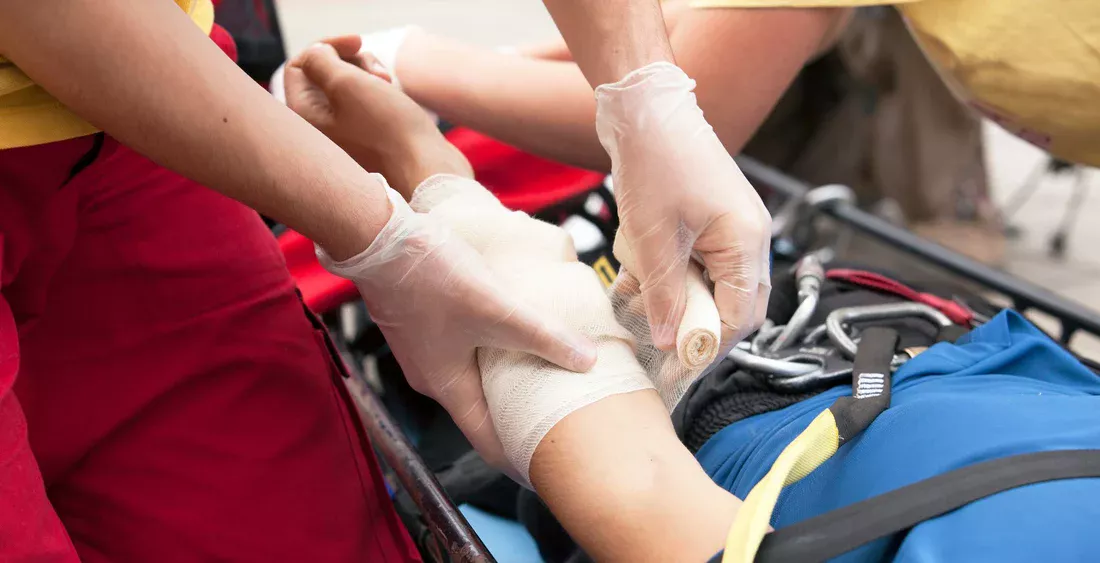
Wear gloves if you have them. Place a sterile dressing, gauze, or the cleanest cloth available over the wound and press firmly with your palm. As per guidance on treating severe bleeding advises calling the emergency helpline when the wound is deep or you are unsure how serious it is.
With an open fracture, press around the wound and not directly on protruding bone. Build a ring of padding around the bone end and bandage over it. Never push the bone back in and never wash the wound.
If blood soaks through the first dressing, add more gauze on top. Removing it disturbs the clot that has started to form.
Once bleeding is controlled, stabilize the limb. Splinting is only needed when help is delayed or the person must be moved.
Practical splinting that works with household items:
- Choose something rigid: a rolled magazine, a piece of cardboard, a wooden ruler, or a folded newspaper
- Pad it with cloth so hard edges do not press on skin
- Place it so the splint covers the joint above and the joint below the break
- Tie it in place with bandages or strips of fabric, above and below the injury, never over the break itself
- Check fingers or toes every few minutes
That last step matters for blood circulation. Press a fingernail or toenail below the splint. Colour should return within two seconds. If the area turns pale, blue, cold, or numb, loosen the ties at once.
For an arm or collarbone injury, a sling made from a triangular bandage supports the weight and reduces pain more than any painkiller does in the first hour.
Cold Therapy, Elevation, and Safe Next Steps
Cold and elevation are the two comfort measures that help before you reach a hospital, and both are simple to get wrong.
Wrap an ice pack, cold pack or bag of frozen peas in a thin towel. Never place ice directly on skin, because it burns. Apply 15 to 20 minutes, then remove at least 20 minutes before repeating.
Cold reduces swelling and dulls pain around the break. Skip it entirely over an open wound or protruding bone.
Raise the injured limb above heart level when you can do so without moving the fracture site. Prop a leg on cushions; support an arm on a pillow across the chest. Elevation works with gravity to limit swelling.
Compression with an elastic bandage suits sprains and strains. Keep compression light over a suspected fracture, because swelling under a tight wrap cuts off circulation.
For pain, ibuprofen or paracetamol taken as directed helps. Hold off on food and drink until a doctor has assessed the injury, since anaesthesia may be needed.
At the hospital, an X-ray confirms the break and shows whether the pieces are aligned. Treatment ranges from a cast or brace to pins and plates for complex breaks, and our radiology and imaging services get that picture quickly.
Recovery does not end when the cast comes off. Physical therapy restores the strength and range of movement lost during the weeks of immobilization.
If pain, swelling, or numbness persists after a fall, come in and get it checked. Primax Hospital, one of the largest and best-equipped hospitals serving Sonipat, operates emergency, orthopedic and imaging care under one roof.
Frequently Asked Questions
What should I do if bone is sticking out of the skin?
Do not touch or push the bone back. Cover the wound loosely with a sterile dressing or clean cloth, press gently around the edges to slow bleeding, and call the emergency helpline. An open fracture needs surgical cleaning within hours to prevent bone infection.
Should I put a splint on every suspected fracture?
No. Splint only when medical help is delayed or the person must be moved to safety. If an ambulance is on the way, supporting the limb by hand or with rolled towels on both sides is safer than fitting a splint you have never practiced.
How long should I keep an ice pack on a broken bone?
Apply a wrapped ice pack for 15 to 20 minutes at a time, with at least 20 minutes between applications. Always place a thin towel between ice and skin, and skip cold therapy over an open wound or exposed bone.
Can a fracture heal without medical attention?
Some small bones do knit on their own, though they frequently heal out of position, leaving lasting pain, stiffness, or deformity. Any suspected break deserves medical attention so the bone is set correctly.
Do I always need an X-ray?
An X-ray is the only reliable way to confirm a break and check alignment, and swelling from a severe sprain looks nearly identical to a crack in the bone. When pain stays sharp over one spot or you cannot bear weight after 24 hours, get imaging done.
Walk in or call ahead: Primax Hospital, Bahalgarh Road, Sector-4, Sonipat-131001, Haryana. Phone +91 96664 60009

